 |
|
 |
|
 |
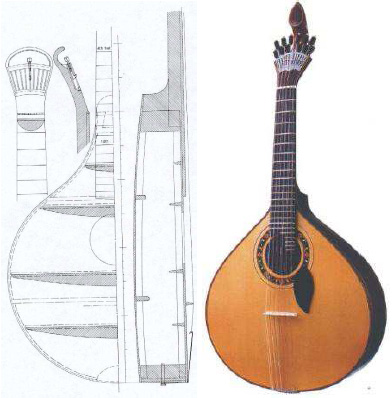
Portuguese Guitar The Portuguese guitar descends from the western European Cithern. Once a very popular instrument with numerous models, during the 16th, 17th and 18th centuries, only a few models survived to the 19th century: the English guitar, from England and northern France; the Thuringian zither from Germany (Fig. 1); the Portuguese mandolin and the Portuguese guitar [1].
Figure 1: German cithern from the ”Manual of Guitar Technology” and Portuguese guitar Each instrument evolved in slightly different ways, changing
the sizes and the number of strings. The curved pegbox was replaced by
metal screw mechanisms for tuning, in some places a rosette was inserted
in the sound hole, and the instruments are less decorated. The English
guitar changed the tuning for a perfect chord scheme (CEG) while the Portuguese
guitar remained faithful to the old cithern tuning.
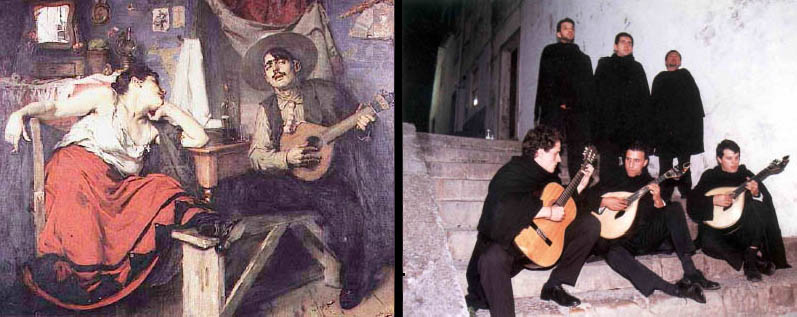
Figure 2: Lisbon’s fado seen by Malhoa at the beginning of the century; Coimbra’s fado As Fado (Fig. 2) started to be a national song we assist
to the rebirth of the instrument in Portugal in the middle of the 19th
century, almost extinct in the rest of the Europe. Around 1870 the guitar
is introduced in the academic student life of Coimbra, in which is still
today, and gaining strength, an important component. The number of skilled
players has rise constantly, namly Anthero da Veiga, Artur Paredes, Flávio
Rodrigues, Carlos Paredes, Antonio Brojo and Antonio Portugal in the Combra’s
style or Armando Freire, Jaime Santos, José Nunes, Raul Nery and
Jorge Fontes in the Lisboa’s style.
[2] - E. V. de Oliveira, Intrumentos Musicais Populares Portugueses. Bertrand, 3rd ed., 2001. [3] - P. C. Cabral, Intrumentos Musicais Populares Portugueses,
ch. Guitarra Portuguesa, pp. 194–199. Further reading: Measurements of String Instruments (pdf) by João Martins Abstract: The aim of this paper is to show an overview of the methods for analysis of string instruments' acoustical and mechanical properties. Some physically meaningful quantities such as the mechanical admittance of the bridge, sound radiated and modal analysis are discussed. The measurement of these quantities is not a straightforward process, all methods having their advantages and drawbacks. Problems concerning the holding of the instrument, the excitation process and excitation signals, and the recording of the response are shown. Finally we use the Portuguese guitar and the Turkish saz as case study. Was presented as part of the the seminar "MEASUREMENTS AND MODELING IN ACOUSTICS AND AUDIO" and published in technical report of the Helsinki University of Technology. Sjokulla 6.5.2002
|
|
|

